


Why Medical Text Data Annotation Requires Clinical-Grade Precision
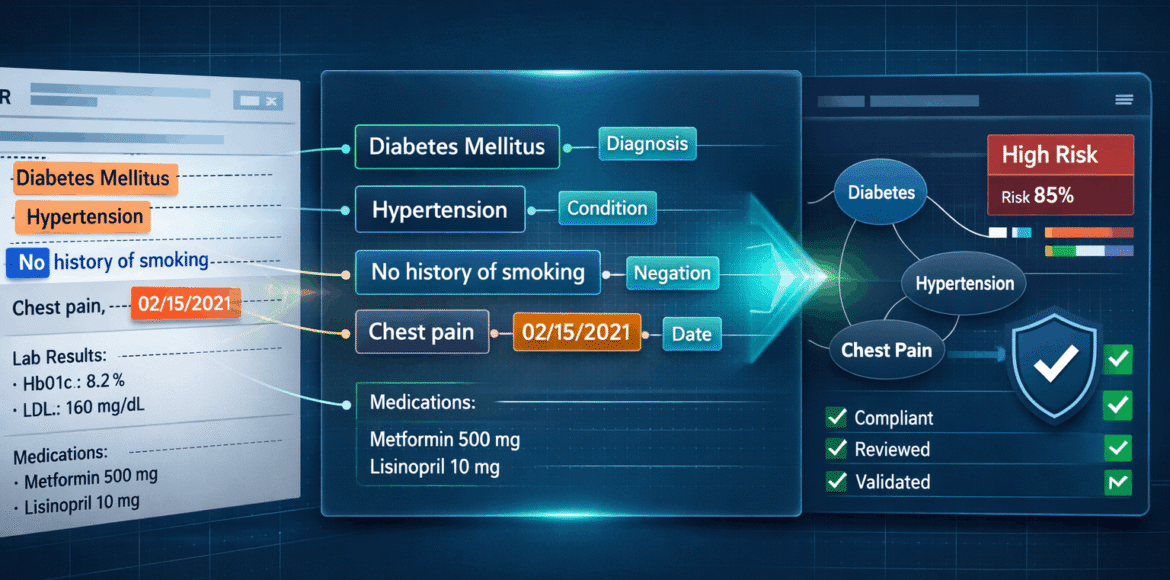
Medical Text Data Annotation is important because medical AI systemsuse precise clinical information marked correctly to make effective and safe decisions. AI models may fail to correctly interpret the records of a patient without specific annotation, and the result of the diagnosis, treatment, or research will be erroneous.
Medical information is complicated, full of jargon, abbreviations and contextual words. Clinical-grade annotation makes sure that all the texts, lab results, prescriptions, doctor notes, or discharge summaries are properly labelled in such a way that they can be processed by AI systems.
Why Accuracy Matters in Medical AI
Medical applications can not afford errors. The simplest mistakes made in the text annotation can be very severe. Medical Text Data Annotation enhances the accuracy by:
- Proper diagnosis of diseases, symptoms and treatment.
- Capturing temporal information like onset dates or duration
- Identification of negations (e.g., no history of diabetes).
Without precise annotation, AI models can generate false reports, overlook important circumstances, or give incorrect advice.
Key Challenges in Medical Text Annotation
Annotating medical text is not like labelling generic documents. It involves field knowledge and detailing. Challenges include:
- The use of ambiguous terms (e.g., MS, which can refer to multiple sclerosis as well as mitral stenosis).
- Differences in using abbreviations in hospitals.
- Complex sentence structures in doctor notes
- Ensuring the confidentiality of patients and regulations.
Professional annotation teams help to be accurate and overcome these issues, and therefore, AI systems can be considered reliable and compliant.
How Clinical-Grade Annotation Improves Model Performance
The adoption of AI models depends directly on the accuracy of their annotation.
The Assistance provided by annotating Medical Text Data is:
- Train models to recognise nuanced clinical concepts
- Enhance natural language processing in EHR (Electronic Health Record) systems.
- Improve predictive analytics for patient outcomes
Clinical decision support, auto-coding and high-confidence research with correct labelling can be done by using AI.
Best Practices For Medical Text Data Annotation.
Medical annotation requires structured workflows and quality control. Key practices include:
Data labelling by expert annotators: Medically trained professionals label data.
- Chain of rule: It is important to ensure that there is uniformity in huge sets of data.
- Multi-level validation: Revision by a group of people in order to detect mistakes.
- Privacy compliance: HIPAA/GDPR compliance during the processing of patient data.
The use of these practices helps to reduce the mistakes and enables AI models to generalise effectively in a clinical setting.
Scaling Annotation Without Compromise.
Medical AI projects need large volumes of textual information.
The advantages of having a professional service of annotation are:
- Label large data sets with little effort.
- Maintain consistency of clinical-grade accuracy.
- Assignments to different hospitals, specialities, or languages.
This enables AI models to be scaled with ease without interfering with the quality or safety of patients.
Conclusion
Medical AI requires data that is highly precise in order to make sound clinical judgment. Clinical-grade Medical Text Data Annotation is needed to make sure that models can comprehend the complex medical terminology, adhere to regulations, and work efficiently in real world healthcare applications. The merging of knowledge, workflow standardization, and multi-level verification can enable healthcare teams to train AI systems that can actually contribute to the improved patient care and safety outcomes.
FAQs
- Why is it more complicated to annotate medical text as compared to regular text annotation?
It entails medical terms, acronyms and situations that can only be labelled appropriately with clinical knowledge.
- Who is supposed to annotate medical texts?
Accuracy and reliability is ensured by trained clinicians or medically well versed annotators.
- Can AI fully automate medical text annotation?
AI can help, although it requires human expertise to be clinically accurate and patient safe.