

Why Enterprises Outsource Audio Annotation Services to Scale Voice AI Faster?
Enterprises outsource audio annotation services to get specialised expertise, faster turnaround times and cost-effective solutions. It enables Voice AI models to be trained efficiently at a larger scale. This approach is used to accelerate development timelines and improve model accuracy.
What is Audio Annotation in Voice AI?
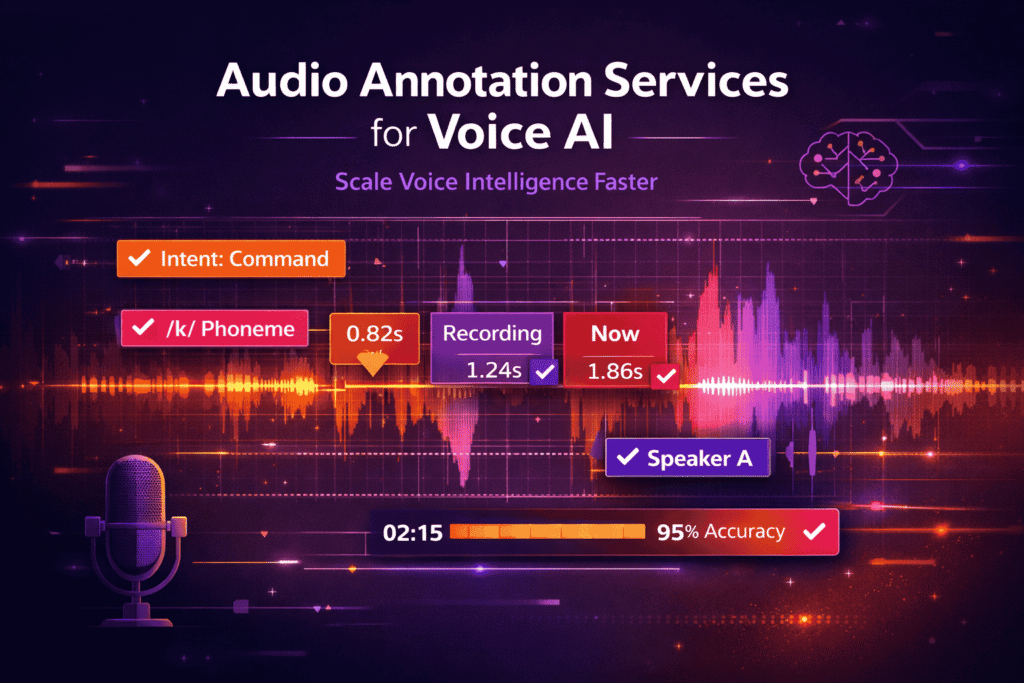
Audio annotation is the procedure of labelling speech data to the machine learning models so that it comprehends, processes and reacts to human language correctly. It is a foundational requirement to build Voice AI systems, such as speech recognition, voice assistants, call analytics and conversational bots:
Here are a few key features that state why businesses outsource audio annotation services:
- Speech-to-text transcription
- Speaker identification
- Intent and emotion tagging
- Background noise labelling
- Accent and language classification
What are the Challenges of Audio Annotation for Enterprises?
As Voice AI systems grow, annotation requirements are increasing for context-aware models to deliver user-preferred results. Enterprises may face challenges to build such systems because of the following reasons:
● Large volumes of multilingual and accented speech data
● Strict accuracy and consistency requirements
● Continuous need for retaining voice data and improving models efficiency
● Data privacy and compliance complexities
Managing these aspects requires significant time, hiring effort and infrastructure investment. These tasks may slow down AI deployment timelines within internal teams.
Benefits of Outsourcing Audio Annotation Services
The main reason to outsource audio annotation services is to solve critical bottlenecks in AI and machine learning development. It is primarily done by transforming raw audio data into structured, actionable datasets required to train speech recognition systems and voice assistants. To narrow down these aspects, audio annotation services can help organisations in the following ways:
Faster Time to Market
Top providers have highly trained annotators, workflows and quality controls in place. This accessibility allows organisations to manage millions of audio files, such as MP3 or AAC files, simultaneously.
Access to Linguistic Expertise
Audio annotation service providers have in-depth expertise in the following aspects:
● Multiple languages and dialects
● Industry-specific terminology (healthcare, finance, automotive)
● Emotion and sentiment detection
Cost Efficiency
Enterprises outsource audio annotation services to convert fixed costs into variable costs by replacing high overhead expenses with a project-based fee paid to the vendor. It helps to reduce administrative costs related to staffing, training, infrastructure deployment and servicing of digital components.
In-House vs Outsourced Audio Annotation
The differences between internal and outsourced approaches become clearer at scale.
| Aspect | In-House Annotation | Outsourced Annotation |
|---|---|---|
| Scalability | Team size limitations | On-demand scaling |
| Turnaround Time | Slower | Faster |
| Cost Structure | Fixed operational costs | Flexible |
| Language Coverage | Usually limited | Broad |
| Quality Control | Requires internal setup | Multiple-level QA processes |
| Compliance Support | Internal responsibility | Established security frameworks |
Continuous Model Improvements
Voice AI systems require constant development of systems to adapt to new accents, environments and users’ intent from search results. To help enterprises, outsourced annotation partners allow:
● Ongoing data refresh cycles
● Quick re-annotation based on model feedback
Conclusion
Enterprises outsource audio annotation services to scale Voice AI faster because it delivers speed, expertise, cost control and quality at a larger scale. As Voice AI adoption expands across industries, outsourcing annotation becomes a strategic decision that enables faster innovations with smooth business operations.
Frequently Asked Questions
1. How do enterprises measure the quality of outsourced audio annotation?
Accuracy benchmarks, inter-annotator agreement scores and model performance improvements are used to assess the quality of audio annotation.
2. Can outsourced annotation workflows integrate with enterprise AI pipelines?
Yes, many providers have API-based integrations and enterprise-ML-compatible data formats.
3. How do enterprises prevent annotation drift over long Voice AI projects?
Enterprises prevent annotation drift by treating data annotation as a continuous, governed and highly technical engineering process. It is achieved through continuous quality assurance (QA) loops and human-in-the-loop (HITL) systems.