

Security, Compliance and Government/Defense Capability Requirements for AI Data Services
AI systems are only as secure as the data that trains them. AI data services must achieve maximum security standards enterprises and government agencies and defense organizations. In parallel, they need to abide by all compliance and governance requirements for use.
There is zero tolerance for mistakes in dealing with sensitive datasets which include surveillance imagery, financial records, medical files and classified operational data. Security and compliance serve as critical elements which establish the base for responsible AI development.
The process of creating AI data services depends on security requirements, compliance needs and public-sector operational standards.
Data Security as a Core Infrastructure Layer
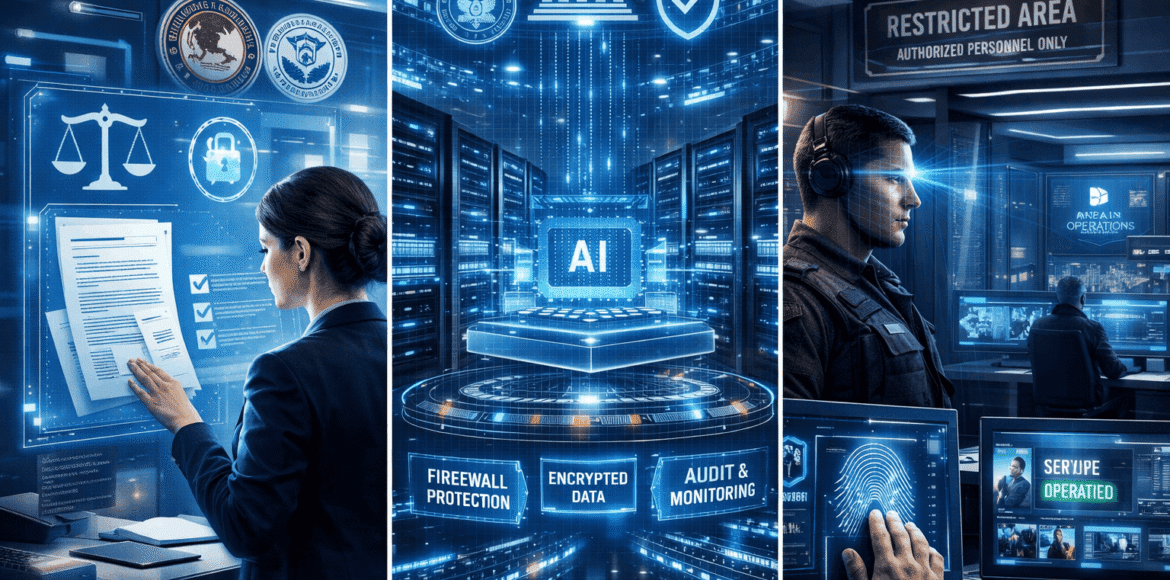
AI data vendors must establish security measures throughout their entire operational framework when dealing with enterprise and government clients.
This process includes
- Complete data encryption to safeguard information during transit and at rest
- Secure cloud environments or on-premise deployment
- Virtual Private Cloud (VPC) setup
- Access controls to restrict system access to designated personnel
- Multi factor authentication protocols
Only authorized personnel should have access to sensitive datasets. Vendors need to create comprehensive access monitoring systems which include detailed access logs. This helps in tracking purposes to prevent any unauthorized data exposure.
Government and defense agencies mandate additional security measures which include isolated network systems and monitored facility spaces.
Global and Sector-Specific Standards Compliance
Compliance helps organizations to mitigate the risk of regulatory and reputational loss. The vendors of AIs have to show compliance with accepted standards including-
- GDPR for data privacy
- HIPAA of health-related data.
- Operational controls SOC 2.
- Information security management ISO 27001.
In the case of government and defense projects, the vendors might be also required to comply with regional data localization laws and with the rules on public procurement.
Certification badges are not the only forms of compliance. It may also include documented policies, periodic audits, incident response documentation and open reporting.
Governance and Data Handling Procedures
Good governance will guarantee integrity of data during the annotation lifecycle. The AI data providers should set
- Well documented data handling processes.
- When necessary, zero-retention policies are necessary.
- Anonymization and masking processes of data.
- Protective information transfer systems.
- Clear-cut procedures on escalation of security incidents.
The government and defense agencies anticipate well-organized governance systems which put accountability into every level. When handling sensitive information clear chain-of-custody documentation is often required.
Impactful governance minimizes operation risk and builds institution trust.
Workforce Security and Operational Controls
Security is not just technical but has a human layer. Vendors serving clients in the public-sector or defense should have in place
- Background check of annotation teams.
- Regulated access to facilities where need be.
- Device usage restrictions
- Non-disclosure and confidentiality agreements.
- On-going security awareness training.
In defense grade projects, further screening of personnel might be compulsory. Managed working conditions and limited data transparency turn into the necessities.
Conclusion
Organizations evaluate vendors based on their technical capabilities and their capacity to protect confidential information. They should be able to follow legal requirements and maintain security protocols.
A secure AI data partnership enhances critical system operations while decreasing business activities. At AIPersonic we believe that In high-stakes environments, readiness is not optional. It is essential.
FAQs
1. Why is compliance critical in AI data services?
Compliance protects organizations from legal, financial and reputational risks.
2. What makes a vendor government-ready?
Strong security infrastructure, audit readiness and adherence to public-sector regulations.
3. How do AI vendors protect sensitive defense data?
They can do it through secure environments, strict access controls, workforce screening and structured governance protocols.